Category Archives: life

Pursue your Passion

Its the only way to do it.
You have to ask yourself
What would I do even if there was no reward?
What would I do even if no one else noticed?
What is that thing that burns within, that drives me to do it no matter what?

When you can answer those questions, honestly you will have found your passion. For me early on it was writing. I have been writing ever since I was very young. Short stories no one read. Novellas I would let some friends read. Journals in marble notebooks. Now blogs and books. One of the key ingredients to following your passion is that you don’t seek the approval of others to follow that burning fire within, you just do it.

When you don’t find it you will know. There is a longing within, a space, a void that needs to be filled. There are indicators that demonstrate you aren’t following your passion- restlessness, discomfort, anxiety, apathy boredom-to name a few. A real easy way to find your passion is to ask yourself this question (in case the above three are too vague). If money were not an issue in your life, what would you do or pursue?  You will find that the answer to this question is your passion.

So what are you waiting for?

Find your passion, pursue it!

writers write

Orlando

Dont strand yourself on an island

Its possible you have heard some of these:

In order to be a writer you must struggle ALONE in obscurity.

There is no way you can write while surrounded by other writers or artists.

Writing forces you to be disconnected and its better that way.

A writer can only truly depend on themselves, no ones knows you like you.

I’m sure there are countless others and I’m here to tell you that its false. Actually I believed this and worse for a long time while I wrote and struggled to identify as a writer. Then I realized, if I am going through this other writers must be going through the same thing. It wasn’t an epiphany, but it was close. So I started to look around and found groups of writers who band together to write or offer support.

There are teachers who will share  their experiences( Julia Cameron comes to mind with  one of my favorite writing book:

The Right to Write http://juliacameronlive.com/books-by-julia/the-right-to-write/

as does Stephen King’s On Writing
 http://www.stephenking.com/library/nonfiction/on_writing:_a_memoir_of_the_craft.html)

 If you haven’t picked up these books please do. They will motivate you and give you a glimpse of what it means to write.

Another great source I have found recently ( OK I’m slow to this) are blogs. There are countless writing blogs in existence but I have found quite a few excellent ones, here are some:

http://terribleminds.com/ -Blogged by Chuck Wendig who is an excellent writer with a very unique sense of humor. On occasion he has guest writers which make for great reading and plenty of useful information.

http://goinswriter.com/– Blogged by Jeff Goins. A very good blog filled with down to earth inspiration and motivation.

He also wrote(among others):
 The Writers Manifesto
(http://www.amazon.com/The-Writers-Manifesto-Jeff-Goins-ebook/dp/B00595KCBI)

 Its a fast read, but a very profound call to action. If you haven’t embraced your calling as a writer this book will spur you to answer that call. Look up Jeff he has some great books that will transform  your view on writing..

There are many more that I will share with you over time, but ideally the key is to go out and connect with others, writers, readers, bloggers, agents, publishers-Basically anyone who loves using words to express themselves. Go find them. Stop thinking you need to be alone to be a writer- I thought that for a long time and its not true. Join a writers club. Find a place where writes converge, online and off.
 In NY we have a few writing cafes that are excellent places to meet fellow writers. Find the one that suits you or create one.
The key is not to be alone in this adventure we call writing.

writers write
Orlando

The Importance of Awareness

An article was recently brought to my attention:

 http://www.huffingtonpost.com/2013/10/08/san-francisco-train-shooting_n_4066930.html)

In the article it describes:
Recently released footage from a Muni security camera allegedly shows that on Sept. 23, Nikhom Thephakayson pulled out a .45-caliber pistol, raised it, pointed it across the aisle, put it down and continued to pull it out multiple times, even wiping his nose with the handgun. Absorbed in their phones, not one of the dozens of passengers reacted until he fired a bullet into the back of Justin Valdez, 20, a sophomore at San Francisco State University.

Before you make any snap judgments about the people on the train lets examine ourselves for a moment.

How often do you check your phone while walking in the street, on the check out line or just waiting? 

When sitting/standing in the train or any other mass transit vehicle are you aware of the people around you or are you immersed in your phone ( or any other technological gadget) oblivious to who gets on or off? 

Do you text while you drive?

How often do you wear headphones (ear-buds) while outside, effectively cutting off your sense of hearing, which is in essence an early warning system?

After reading this article I took an informal survey as I rode the train in New York City. On one random subway car alone more than half the people in the car were immersed in some sort of device completely oblivious to those around them. Another large group were dozing or had their eyes closed.

As I walked down Broadway, I counted on one block ten people with ear-buds or headphones who would not have heard me if they were in danger and I needed to call out for their safety ( I tested this by just saying “Excuse me.” while behind or beside them. Only two people registered that they heard me.) The others couldn’t hear me because the music was audible from where I stood, about 3-4 feet away. Three people had to stop short at intersections before crossing the street because they were crossing against the flow of traffic and didn’t notice, they were all texting or reading their phones.

As I proceeded  on Broadway I attempted to get close enough to invade personal space, from the side, rear and front. I used ploys like asking for time and directions or just acted creepy and tried to get  real close. Yes it was a busy afternoon, but I really wanted to see what the level of awareness was. These exercises didn’t take more than an hour. Out of the twenty people I approached in a five block radius (I was on Broadway and 79th street), sixteen of them allowed me into their personal space. After I closed the distance I informed them that they each could have been a victim, some laughed it off and most dismissed it, it was the middle of the day after all and  no one gets attacked in broad daylight, right?

Its this awareness that we stress so much in self defense classes. Awareness or situational awareness as it is sometimes called is the act of not walking around in a fog.  You will often hear when people are attacked or when incidents occur that it just happened ” out of the blue” or “I never saw it coming”. In the case of blindside, ambush attacks or spontaneous acts, this may be possible, the other times however you just weren’t aware.

If you drive you need to be even more aware. I wont go into the amount of people I have seen driving and looking down at phones or just not focusing on whats in front of them. Considering that even a small vehicle can weigh a few tons its in our best interest to focus and be aware while driving what is essentially a large battering ram capable of wreaking devastating damage.

This lack of awareness is becoming more and more prevalent. Not only because of technology. I think the technology just facilitates it, but rather we need to shift our attitude of ” I’m not going to get involved, or ” It has nothing to do with me”. When we choose to be this way we are passively saying-I don’t care.

I invite you to try some of the exercises I did. See how close you can get to other people in normal settings
 ( please don’t get yourself arrested) without them noticing. Understand that those who would victimize others are doing the exact same thing.

Make the choice to be aware, look around on the bus, train and the street you walk down. Unplug the headphones / ear-buds and engage all of your senses. Cultivate a  radar of who and what is around you, this does not mean you walk around paranoid all of the time, but aware. One of the first things we teach in our self defense classes is awareness and its importance. It doesn’t matter how skilled or trained you are if you are walking around in a fog, oblivious to your surroundings.

Keep your eyes and ears open.

strong spirit-strong mind-strong body
Sensei Orlando

The thick skin you need as a writer

So I am getting responses back from some of my beta readers. Most are saying that they love the story (Blur) and then like the inevitable breakup conversation that starts with “we need to talk” they begin.

“Loved the story, but why is this happening or why is this character doing that?

“It was great but this doesn’t make sense.”

You get the gist I’m sure. Now just to be clear I enjoy this, actually I asked for it. Its part of the writing process and as amazing as I may think I am ( in my own mind) I know better. Its important to put your story and yourself out in front of others to get feedback and criticism, because it helps you make the story better. That is the point isn’t it? A pairing down of things unnecessary and superfluous. In order for all of this to work however, you need thick skin.

You need to be able to take criticism, constructive and destructive and move on. You cant take it personally even though you want to, and I know you really want to, but don’t. Remember, focus on the story, its all about the story. You as the writer can fade into the background, but the story should shine in the foreground. You need to be able to look past the battering of your story, characters and even writing ability to continue writing. In my opinion, if you cant do this you have no business writing, really.

This doesn’t mean you should only subject to criticism that destroys your work. You should pick your early readers with care, people that will read your work and be honest  and supportive of you being a writer. If you only want glowing reviews (and who doesn’t) then only use your family. That way you can get a skewed review in your favor (its delusional, but fun). If you want honesty, pick people who like you, but are not afraid of telling you the truth with compassion. That last part is important. Writers tend to be sensitive individuals who bruise easily. This is all done with the understanding that you must release your story into the world, and not everyone will be kind or a fan. Remember to be your own greatest fan.

If you are a writer then cultivate the thick skin needed to hone your craft and undergo the scrutiny required to improve from being a good writer to a great one. If you ever find yourself fortunate enough to be an early reader of someones work remember that the point is to make the story better without destroying the writer in the process. Think surgical strike instead of  a slash and burn policy. Focus on the writing not the writer and you will be sought often to improve those nascent novels.

writers write

Orlando

Instructor Interview-Sempai Orlando

This week I will post our first instructor interview. Each month I will interview one of our instructors so that you can have a glimpse into some of the inner workings of our school and the people that teach and train there.

This weeks interview will be Sempai Orlando. In addition to being an instructor in our school, he is also the off site director for our after school programs which is currently taking place in two New York City public schools. On average between the two schools he is teaching karate to 30 children every week.

EH: Thanks for taking the time to do this interview, I know you have a busy schedule between teaching and being a full time college student and trying to have a social life.

SO: Thank you for letting me be part of the blog. I read it often and really like it. Most of the times its a continuation of the conversations I have with the sensei.


EH: OK so lets begin. Lets start with your age. How old are you ?

SO: I’m 18 years old.

EH: What are your goals in college?

SO: Well this is my first year so its been a big change for me. My goals are to be a physical therapist ( I enjoy working with people) and also to learn stage and film combat. I have choreographed a few fight scenes and did one for a short film my older brother filmed.

EH: Do you have any specific challenges training at your age?

SO: I think the biggest challenge right now is balancing my school work and my training and teaching. I usually have to wake up very early to do my own personal training, then I have to get ready for school. I have a heavier load of school work now so it means I have to be very conscious of how I manage my time.

EH:  How early do you start your day and what does your training consist of ?

SO: On the days I can train in the morning I’m up at 4 am. My training consists of a lot of conditioning ( I punch and kick trees to toughen certain areas), I also work a kettle-bell routine and then I finish with body weight training-what we do in our classes: push ups, sit ups, squats.

EH: How long have you been training?

SO: I have been training for 13 years. My first dojo was our garage, when I was real young. The class size was pretty small since it was just me, after a while my younger brother joined us.

EH: Why did you start training?

SO: I started training because I saw my dad always training and I wanted to be just like my dad.

EH: Was your dad your first instructor?

SO: Yes, I started when I was five so he was my first teacher. I have also trained with Sensei Orhan from a Kyokushin school in Queens. I’m still beginning so I haven’t had that many teachers.

EH: Why do you continue to train?

SO: I continue to train because it has become my passion.

EH: Have you ever wanted to stop training?

SO: When I was younger I wanted to. I felt that it was too hard and that I wasn’t very good at it.

EH: Why did you continue?

SO: Honestly? My dad. He just kept telling me I would get better. That it would take time and that if I didn’t give up he wouldn’t give up. Also if I gave up, he still wouldn’t give up. After a while I did get better and I started to like it.

EH: What part of training do you enjoy the most ?

SO: I enjoy the energy I feel in a class filled with people that are willing to push themselves past their limits. It pushes me to try harder and to push myself as well. It reminds me of one of the characters (kanji) we have on our main wall, ren ma-it means keep polishing. Training like that is part of the polishing. I also enjoy kata, except when I have to do it in front of the sensei, it always feels like I just learned it when I do it with him.


EH: What part of training do you least enjoy?

SO: The pain my body feels when I do certain exercises, even though I’m used to them. Getting hit when I fight the sensei. I definitely enjoy that the least.

EH: Why did you take on teaching?

SO: I teach so I can share my knowledge and experience with others. Also I love working with other people.

EH: You have competed in several tournaments and done well. You have also expressed that you will no longer compete in tournaments can you tell us why?

SO: I think tournaments are good for what they are-contests with rules. For me my practice is about being a warrior.When we fight we punch to the head, we also grapple, kick to the thigh, use joint locks, submissions and do ground work. I was disqualified from one tournament because I tapped my opponent on the nose and he bled a bit. It wasn’t right or wrong, those were the rules, but it was not the way I learned to fight so it was difficult for me to adapt.

I train differently than most people I know my age. I don’t think tournaments are bad, but they aren’t for me and they don’t reflect what I have been taught. I usually see a lot of pride and egos at tournaments, which to me is the opposite of what training should be. Also I have seen some kata tournaments and it doesn’t look like kata at all, its more like dance moves and back flips choreographed to music with kiais that last about two minutes. I would never be a part of something like that.

EH: Any advice for someone just starting on their martial path?

SO: If you feel that a martial art is something you want to pursue, begin and don’t stop. You’re going to face a lot of challenges along the way but the payoff is worth it. Keep on training, ask questions learn as much as you can inside and outside the dojo. Sensei is always giving me a book to read, its usually related to martial arts but sometimes its not. Always try to better yourself, its never a competition with other people.

EH: Thank you again for giving me the time to interview you.

SO: You’re welcome and thank you for letting me be part of the blog.

Sempai Orlando comes across as a very reserved (and older than his years) young man. In the dojo he is known for his affable manner and tough classes. I hope with this interview you have gotten some more insight into one of our instructors.

strong spirit-strong mind-strong body
Sensei Orlando

For questions or suggestions on future topics contact: sensei.orlando@yahoo.com
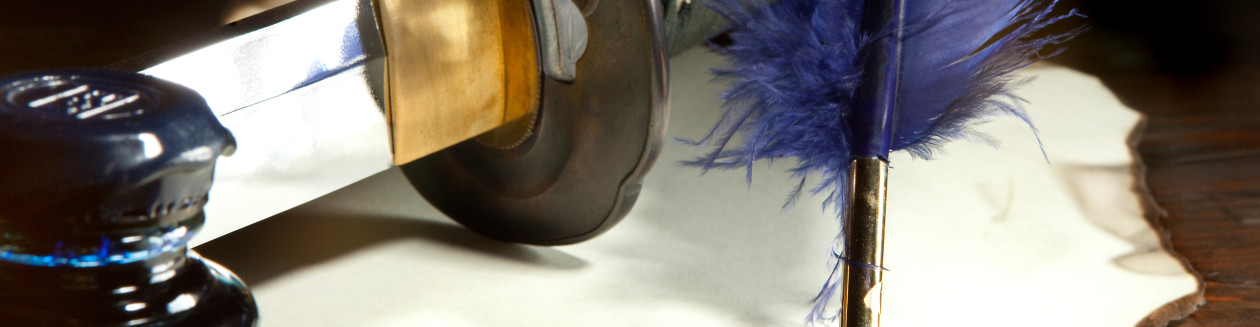
Embracing the title

What does it mean when I say I’m a writer? Does it mean I spend my time engaging in flights of fancy? Do I hear voices in my head and more importantly, write down what these voices say?

Honestly its hard to pinpoint the exact definition. It does mean I enjoy and strive to hone my craft of conveying story through the written word. It means that I believe in story and good storytelling. Ultimately I think being a writer and embracing the title means, to me, that the activity, the action of writing takes on a life of its own in my life. Its not that I like to write ( I do) it is that I have to write. Its one of my methods of self expression. From journals when I was younger to blogs now, writing has been a central theme in my life. I don’t think you wake up one day and decide, ” I’m a writer.”  What happens is that over time you realize that this is your preferred method of telling a story, yours or another persons ( real or fictitious) and at some point you embrace the tittle of writer.

Two things can occur at this point You can rebel at the thought of being a writer, even if you have embraced the title. The self doubt rears its head and surreptitiously whispers in your ear that you aren’t a “real” writer- whatever that is. Or you completely accept being a writer and revel in the process of it all- from agony to elation and back again, over and over. I can say that for me I am still wrapping my head around the idea of being a writer even though I have done some form of writing my entire life.
My opinion is that no matter how long you have been doing it, on some level I don’t think you ever get truly comfortable with the title.

Maybe that’s a good thing.

writers write

Orlando

Beta Readers

I’m one step closer to getting Blur published. Currently its in the hands of five beta readers and yes its like the first time you hire a babysitter to watch your child, the most precious thing to you in your entire world-very close to that feeling. I have never done this before ( this is my second novel being published), but I felt that with this novel it was warranted and I think it can improve the overall quality of the book. Do I like it ? Hell no. Its like I’m in a weird place-a sort of writers limbo where my book is being subjected to the scrutiny of others, my characters tortured, unmasked and deconstructed. Yes I know this is not rational thinking. I’m a writer, I specialize in non rational thinking. Not only that, I actually asked for this.

So what do I do in the meantime? I write. I edit my next project-a book on fatherhood that I will release around the same time Blur comes out. I write the second book to my Spiritual Warriors series- The Ascendant Warrior. Basically I keep writing because, I cant stop and because to not write is to invite simultaneous brain implosion and explosion. Writers really do hear voices in their heads. Letting these voices loose with a system of checks and balances, well no matter how I envision that scenario its not a pretty sight. I say that last bit with the utmost seriousness and hilarity. See what I mean?

And so I keep writing, Ill let you know how it goes.

writers write

Orlando

Together on an individual path

There are no mirrors in our dojo.

There are several reasons for this:
For us its not practical, the wall space is being used by other items ( for example, weapons).
Its dangerous. We have, what one senior calls a ” functional dojo”. The weapons on the wall are all real and available when fighting occurs (provided you know how to and have been trained in using the weapon). With the exception of the ceremonial (yet very real and sharp) katana which are out of the way of the curious children’s hands, every other weapon is at an accessible height.  In our school, when we fight, being kicked  into a wall or thrown into the wall as part of a self defense scenario is a very real possibility.The two craters we have caused (I was involved in both and they have since been patched)  in our wall attest to this. Getting thrown into a mirror usually ends up with a visit to the hospital E.R. and presents a hazardous situation to other students.

The main reason we don’t have mirrors however is that it allows you to remain focused.
I have studied in dojos with mirrors and I am aware that the only ;person I need to be looking at in the mirror is myself. Usually that is how the class will start out. I will be focusing on myself and then one of my classmates will execute a technique that’s higher than mine or faster and I will find myself inadvertently comparing my techniques to theirs. Its not a conscious act, this is all happening on a subtle level that requires constant vigilance. If left unchecked it becomes a full blown expression of ego in a place where ego is not welcome. This has the potential to occur in any dojo. What I have found and what has been my experience is that when there are no mirrors, it limits the distractions and allows for greater focus.

I always tell the students, when you are training don’t look left or right focus on what you need to do. Don’t compare yourself to others, especially in the dojo, because there is always going to be someone stronger, faster, more naturally gifted, or more proficient. If you look around you can always find an excuse not to try harder, not to give it your all. That is not the purpose of the dojo. When you enter on the floor the only person you need to be thinking about is that person you were the last time you stepped on the floor. Were you able to do ten push ups last time, well aim for fifteen this time or twenty. Maybe last time your body wasn’t at 100% and today you feel much better, then you push yourself harder today.  The inverse may also be true and you may need to scale back the training today to take into account that your body may feeling sub par.
So here is the other side to that situation.  Since we are travelling together on this individual path, it is my obligation as someone who may be along further on the path to help out those who have just begun. This is the essence of the Sempai / Kohai relationship. Those who are seniors help those who are juniors. The juniors will look to the seniors to see how things are done. In a very real way the seniors are the mirrors for the juniors. This has been driven home recently by our two young green belts who have taken on assisting as part of becoming green belts. To reach green belt in our school means that on average you have been training for 3-4 years. They are not in the strict sense, beginners. Yet when these green belts were placed in front of white belts  to teach them basic techniques, I could see the nervousness and the excitement. It has added a dimension to their path that they were not aware of and now they are realizing that you do not truly learn until you have to teach another.

In our lives we would do well to adopt this attitude of focusing on ourselves and yet not forgetting those who come after us. I know it has served me well in my martial path as well as my writing ( where I am the novice). We have to stop worrying so much about what others are doing and pursue our lives, our passions and those things that bring us joy and excitement. The key is not stopping there, but encourage others, through your example, your words, and actions to do the same. When they need help offer it.  Sometimes its a gentle nudge, sometimes it needs to be gentle shove, but if you do it from a place of truly seeing others grow and have their lives transform for the better, then its worth it.

strong spirit-strong mind-strong body
Sensei Orlando

Next week: I will begin the instructor interview series and feature one of our instructors in the post. If you have any questions you would like to ask an instructor please email them to me at sensei.orlando@yahoo.com

The Warriorship of Women

Settle in and get comfortable, grab a cup of your favorite beverage, this is going to be lengthy post.

Last month I was involved in a conversation with some fellow martial artists ( men and women) about how women have been oppressed since the dawn of time on a global scale. That is not the topic of this post, nor have I been on this planet since the dawn of time so I cant offer a point from that perspective. However, one point that was brought up in the broad scope of the topic specifically focused on how women have not been allowed to be warriors. Could they be warriors now in our modern age?  We discussed it back and forth, but the thought stayed with me. Can women be warriors? Have there ever been female warriors or has this always been a male dominated subculture?

Before I even went into history to examine the veracity of the statements made by my colleagues, I drew on my own experience. I have been in several schools in my martial path. All of them had a mixed population, although the harder styles tended to lean towards male students. I wondered if this was because the style was hard or were the women being treated differently? I took some impromptu polls of female students and found that in some schools they are treated differently than the men. For example, some women have been cautioned against doing push-ups off their knees because they are perceived as not strong enough. Others were told that they couldn’t strike certain surfaces because it was too hard for a woman.

In my personal experience I have stood in front of some formidable female warriors. In most cases I outweighed them by a good 50-100 pounds. Not one of them flinched at this size or weight disparity, in fact they relished it because it allowed them to really execute their techniques. One senior student used to stand about six inches away from me and still manage to kick me in the head full force. Another was such a technician with her hands and evasive maneuvers it was like fighting smoke, until you got hit. Were these women the exception? I don’t believe so.

So lets see if there are any precedents.

Fu Hao was one of the many wives of King Wu Ding of the Shang Dynasty and, unusually for that time served as a military general and high priestess.

Tomoe Gozen is thought to have been a late twelfth century female samurai, an onna bu geisha who may have pioneered the two sword style made famous in the 17th century by Miyamoto Mushashi.

The daughter of a Duke, Princess Pingyang raised and commanded her own army in the revolt against the Sui Dynasty. Later on her father would become Emperor Gaozu.

The Spartan princess Arachidamia is said to have fought Pyrrhus ( of the phrase pyrrhic victory) with a group of Spartan females under her command, and killed several soldiers before perishing.
The British Queen Boudicca led a revolt against the Roman Empire in 60 AD, but was decisively defeated.

Emilia Plater was a Polish noblewoman who fought as a Captain in the November 1830 uprising against Russia.

The Roman Empire was known to occasionally have women fighting called gladiatrix.

The Dahomey a people who live in Western Africa  established an all female militia, who served as  royal bodyguards to the king.

In Native American history, most of the Native American tribes contained a group of respected and well established women who were leaders of their militia. These leaders determined the fate of prisoners of war among other tribal decisions. Europeans and early American settlers refused to deal with the Native American women on such matters leading to their significance not being understood or appreciated until fairly recently. 

In Vietnam the sisters Trung Trac and Trung Nhi led a rebellion against the Han rule in 40 B.C. According to tradition they were joined by many women warriors and succeeded in establishing a short lived independence.

In South Asia and the Indian subcontinent the concept of woman warrior exists both in the mythos and in history. Rani Lakshmibai of Jhansi was one of the leading figures of the Indian Rebellion of 1857 and was described as “remarkable in beauty, cleverness, and perseverance. She was also considered the most dangerous of all the rebel leaders.

In Indonesia, Martha Christina Tiahahu joined a guerrilla war against the Dutch Colonial government as a teenager in 1817.

Lyudmila Pavilchencko was a Soviet sniper during World War II, and is regarded as the most successful female sniper in history.

This list is by no means exhaustive, however the examples set the precedent for female warriorship. In India which is considered the birthplace of martial arts by many, there are still many female warriors, specifically training in Kalari Payattu.
The word Kalari means practice ground in Malayalam.  The traditional training ground of Kalari Payattu , a martial art of Kerala which is a state in south India, is always done inside the Kalari which literally translates to threshing floor or battlefield. Payattu means exercise in arms or practice.
Kalari playgrounds have, for centuries been used by both, men and women. Historically when men went off to fight battles, young women were often left behind to defend their villages and families. Women also trained in Kalari were able to resist invaders and bandits along the roads. Those who were from a higher caste also had access to a wide array of weapons at their disposal. Those from lower castes used ordinary utensils such as knives, anything and everything was considered a potential weapon. The lower castes also specialized in a more sophisticated from of empty handed combat. 
Kalari also had a place of some importance in the education system  in ancient Kerala. Today Kalari Payattu is a method of physical fitness divided into several schools- Thekkan and Vaddakan being two of the most known. It is a system that even today teaches young girls hand to hand combat.

So what has happened?  Why are women viewed as inferior warriors by modern society. especially in schools that teach martial arts?  It could be said that the media has played a role in this even though there are now more strong female protagonists. It could be that society is finally acknowledging women as warriors after a long time of denial. Whatever the case may be, there is a definitive shift in the perception of women as warriors taking place. I would argue that this is not a new trend but rather a return to a state that has always existed. 

So I presented a problem, let me suggest a solution. I wont say its the only solution, but it is a solution I can actively employ. In our school, we are what I like to call gender blind. Our instructors look past gender when training a student. What is taken into account is ability, mastery of technique, determination to learn, and character. These traits are not gender specific. In our school we believe in cultivating warriors, not tournament champions. That is not a slight against tournament based schools, I think tournaments have their own place in the martial world. It is just not the focus of our school. This means we do not make exceptions based on gender and we expect our students commitment to be based on a warriors mindset, male or female. If more martial arts schools adopted this stance I think we would cause more of a shift in the perception of women as warriors.

Its possible you may be thinking-well that’s a good sentiment, but pound for pound a man is stronger than a woman. Being stronger, the man will win in any conflict. I disagree, but let me share an analogy that stresses the importance of technique.  My instructor, a Shihan- used to explain it this way.  The explanation was usually in response to my question of outweighing him by 100 pounds and he was still able to easily deal with my attacks. He would say ” If I take a bullet and throw it at you, at most it will annoy you and be ineffective. If I take that same bullet, put it in a gun-the same small piece of metal has devastating consequences if shot at you, and connects.” This is why we stress technique over strength. Its not that I feel strength is overrated, its good to be strong (we certainly do enough conditioning to support this fact), but if I had to choose between strength and technique I would choose technique-always. It has been my experience that technique overcomes strength when they meet.  This is why the females in our school are expected to be as  formidable as the males.

I was recently shown this in my weekly jujitsu class.  During class we working on a wrist lock and throw. The person I was paired with was a senior both in rank and in age ( she was easily ten years my senior). Whenever I am with a senior( in rank) I like to ask questions. In this case I presented the scenario that what if I just held my wrist in place could she still execute the lock and throw?  She said “Well why don’t we try and see if I can?”  I proceeded to attack, she sidestepped, grabbed my wrist locked it and flung me easily. “I guess it does work” she said as she smiled at me while I lay on the floor. Just to make sure I understood the mechanics behind the exercise we worked on the same sequence for an hour. It was a literal, visceral (and jarring) lesson. When I did execute the sequence on her, it required no strength on my part but rather a shifting of the hips and unseating her balance. she reminded me that its not the strength that makes it effective-which is why so many people make mistakes, but rather proper technique. The technique is the foundation she kept telling me.

So what does this all mean? Well, if you are female and reading this post I encourage you to embrace the spirit of warriorship. If you are male and hold a different opinion than the one I shared here, that’s fine. We are all entitled to our opinions, I would challenge you however to open your thoughts to the possibility that women are as capable as men in being warriors. 

I recently heard an interaction between my wife and one of my daughters. The context was that my daughter had hurt her knee. My wife went over and quickly addressed the situation acknowledging that bumping your knee hurt, but then she said something truly profound.  She looked at my daughter and said” We aren’t going to let that stop us though, right? ” My daughter nodded still in pain, but smiling.
“Do you know why not?” she asked my daughter.  Together in a rising crescendo they both answered.
” Because we are Warriors!” My daughter ran off to continue playing.

The warriorship of women has a long and rich tradition in history. It is up to us to make sure that in continues into the next generation and beyond.

I would like to hear from both my male and female readers. What are your thoughts? Agree or disagree? Lets continue the conversation.

strong spirit-strong mind-strong body

Sensei Orlando

The Power of Sitting

Everyday I sit for fifteen minutes. Everyday. You may be saying, well that’s not a very long time, and you would be right. Fifteen minutes of your day is actually a very small amount of time. Or you may be saying ,well I sit everyday for hours, whats fifteen minutes?

 Well let me clarify my definition of sitting. For fifteen minutes I intentionally sit in zazen (seated meditation) and still my mind. The running track we all have in our heads gets quieter. I connect to my breath on a deeper level and I just am. On some days (more often than not) those fifteen minutes feel like an hour. Bombarded by random thoughts that seem to be waiting for just this moment to assault me, I do my best not to hold on to any of them. Rather I am an observer as they come and go, always returning to the anchor, my breath. On some rare days (very rare days) the time seems to pass by in a compressed manner. Fifteen minutes seems like five and I marvel at the relativity of time in the context of perception.

So why should you sit? At the very least it gives you quiet time to yourself, to be with you. It highlights ( at least for me) the deeper level of connection we all share. When I sit I can “see” that I am part of a greater whole. Sitting also serves to focus your breathing. You will notice your breathing pattern withing the first minute. We have a tendency to breathe from our upper chest, shallow and rapid. When you take a moment to focus on your breath and move it downwards to your diaphragm, you fill your lungs, oxygenate your blood to higher degree which in turn sharpens your thought process.
 Let me list some of the benefits of meditation, I wont go into detail since there are many sources of information on this:

  • Increased pain tolerance
  • Decreased stress
  • Higher cognitive function as you age
  • Access to greater creativity
  • Stronger immune system
  • Lower blood pressure
  • Emotional balance
This short list presents some very good reasons to sit for a few minutes each day and breathe.  

The list is by no means exhaustive and yet if there were a pill or a drink that offered all of the above, people would get it in droves.When we find out all you have to do is just sit for a short time each day, it seems too good to be true.

 When we train in our school like many other styles, we start and end our training with a moment of seated meditation. It is actually a moment of reflection and contemplation on our training path. It prepares us for the class that is about to begin, and at the end of class it allows us to reflect on the class that just took place, our performance and where we need to focus in our training. We prepare ourselves to leave the dojo and to face the world once again. While this sitting is essential to training, it is the sitting we do in our daily lives, the one we make part of our day that effects a change in us.

We have a tendency to live our lives at a breakneck pace. Our days are full of activities and we are constantly running from dawn until we go to sleep. In the course of all this activity (because many of us will say I don’t have time) I invite you to allocate 5-15 minutes just to sit and be still. Some of us will find this very easy. Most will find it difficult at first. What do you mean be still? Do you mean not do anything? Does this mean I cant go online, get on the phone, send a text, read my email and call someone?  If that sounds like your idea of  not doing anything this will be a real challenge for you. 
For 5-15 minutes just sit and focus on your breathing. Period. 
Give it a try and let me know how it goes, I will be curious to hear the stories. Leave me a comment.
strong spirit-strong mind-strong body

Sensei Orlando